
Architecture Lifecycle.
How the corporate website is structured, why its components fit together, and how its design evolves.
Architecture starts with responsibility.
The architecture separates public presentation, server-side integrations, approved content and publication evidence. Each component has a purpose and a defined boundary.
This page describes the Continuum Group Ventures corporate website. The system map reflects the current implementation. The lifecycle stages and decision criteria explain how architecture changes should be assessed; they do not certify that every historical decision has a completed formal review.
Astro provides the page and component structure, Wix Headless provides the connected hosting environment, and the official GitHub repository provides source history. These responsibilities are related, but a source commit, compiled build and confirmed deployment represent different events.
Explicit responsibilities.
Keep visitor presentation, content ownership and privileged server operations understandable and independently reviewable.
Measured change.
Reuse established components, preserve working journeys and plan a recoverable transition when behavior changes.
Traceable decisions.
Connect a design change to committed source, relevant validation and the resulting public release record.
One website. Distinct responsibilities.
The illustration separates the request path from content retrieval and publication. Connections show logical dependencies, not a network or provider-infrastructure inventory.
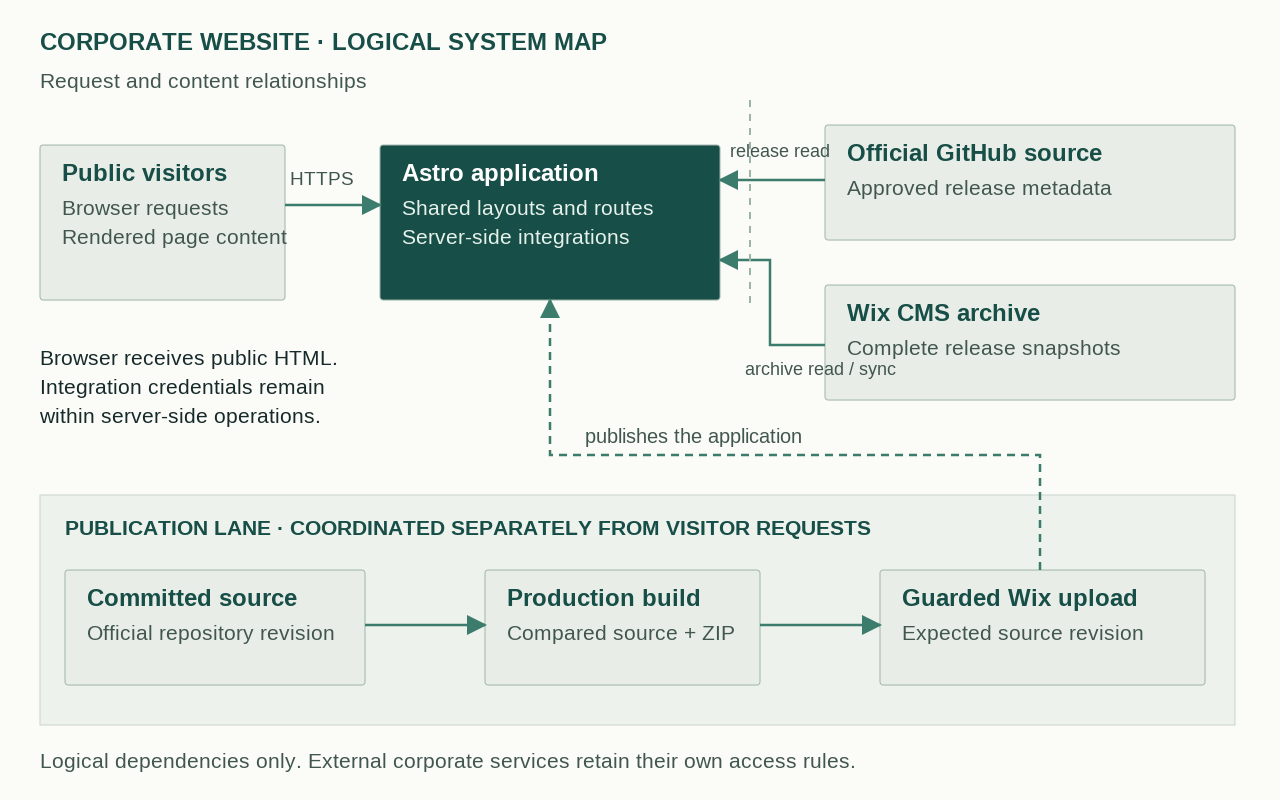
On a small screen, scroll the diagram horizontally or open the full-size image.
| Layer | Responsibility | Boundary or constraint |
|---|---|---|
| Presentation | Shared Astro layouts, corporate pages and browser scripts. | Rendered HTML, approved public content and interactions. |
| Application server | Server-rendered pages and existing validated HTTP endpoints. | Privileged operations stay behind server-side validation; they are not implied by viewing public documentation. |
| Release source | Approved release metadata retrieved from the official GitHub repository at a pinned commit. | Read credentials stay server-side. Record fields are validated before public display. |
| Release archive persistence | Complete release-note snapshots and generated release IDs persisted through the Wix CMS adapter. | Administrator-only collection access; the server controls synchronization and public projection. |
| Build and hosting | Astro production output packaged for the existing Wix Headless site. | A build identity identifies compiled source. Repository activity alone does not publish a website. |
| External destinations | Corporate intranet, CTIDL, Continuum Verify and the service-status provider. | Each destination retains its own access rules. Corporate redirects use the existing confirmation flow where configured. |
- Astro 7.4.13
- Wix Astro integration 3.1.2
- Wix hosting adapter 3.0.5
- TypeScript 7.0.2
A design that can evolve.
Architecture is revisited when requirements or evidence change. Each stage identifies an output that helps the next decision.
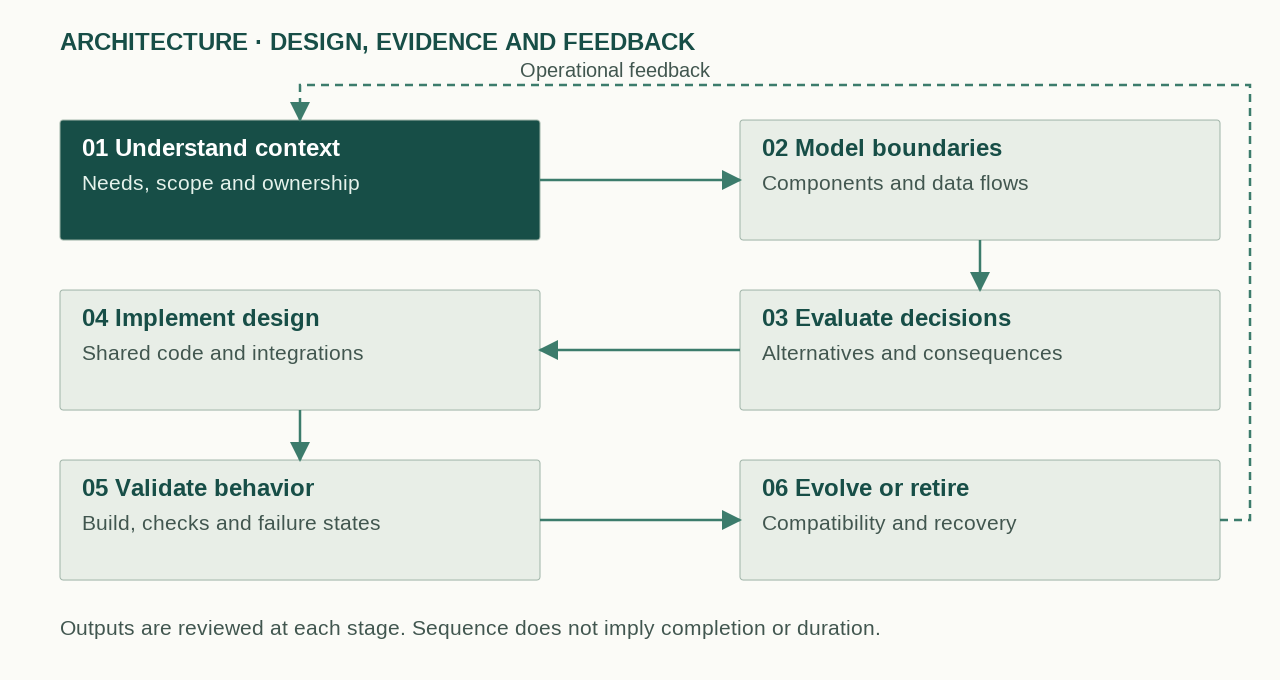
- Architecture stage
Understand the context
Identify the visitor need, information owner, affected journeys and the source of authoritative content. Establish which parts of the corporate website are in scope and which services remain separate.
Expected output: A bounded change statement, affected routes and constraints.
- Architecture stage
Model the architecture
Describe the browser, server, content source and hosting responsibilities. Trace where data enters, where it is validated and which responses may be public. Separate content updates from application releases.
Expected output: A component map, data-flow sketch and explicit trust boundaries.
- Architecture stage
Evaluate decisions
Compare the proposed change against the existing stack, accessibility, privacy, operability and recovery requirements. Record why a simpler shared component, managed service or isolated endpoint is appropriate.
Expected output: A decision record with alternatives, trade-offs and unresolved questions.
- Architecture stage
Implement the design
Translate the selected design into shared layouts, page components and bounded server adapters. Keep privileged integrations on the server and preserve existing content and route behavior.
Expected output: Committed source and documented integration assumptions.
- Architecture stage
Validate the architecture
Check the production build, affected journeys and failure behavior. Confirm that public metadata is filtered, source identity is stable and unavailable external data has an honest fallback.
Expected output: Scoped test results, source comparison and live verification evidence.
- Architecture stage
Evolve or retire
Review changes when requirements, dependencies or provider behavior change. Plan route transitions and compatibility before retiring a component. Track the effect on content, data and recovery separately.
Expected output: A migration or retirement plan and a reference to the resulting release.
Publish the information a visitor needs.
Public display is a projection of approved data. Repository access, content persistence and corporate authentication remain separate concerns.
Release information flow.
- The server reads approved release metadata from a fixed official repository and pins the content read to a returned commit reference.
- Schema validation limits public fields, bounds input sizes and excludes draft or private release records.
- The release-note adapter persists validated complete snapshots in Wix CMS. A partially written set of rows does not replace a complete public archive.
- When upstream retrieval is unavailable, cached, CMS or bundled recovery data are labelled according to the source actually used.
Interaction boundaries.
- The browser receives rendered public content and the scripts needed for its visible controls.
- Server integration credentials are not included in public release metadata or diagrams.
- The employee portal opens the official external intranet through the existing redirect-confirmation interaction. The intranet applies its own authentication and permissions.
- This architecture overview concerns the corporate website; it does not describe the internal implementation of Continuum Verify or corporate productivity tenants.
Review an integration’s deadline, stale-data behavior and visible error or fallback message before adding it. An available cached page and a fresh upstream record are different outcomes and should be described accurately.
Make the trade-off visible.
The table explains implemented choices and their consequences. It is a qualitative comparison, not a scored benchmark or independent security assessment.
| Decision | Current implementation | Trade-off to review |
|---|---|---|
| Server rendering | Public pages use the project’s server-output configuration. | External reads need deadlines and recoverable display states; runtime rendering is not a guarantee of fresh upstream data. |
| Shared site layout | Navigation, branding, footer and accessibility conventions are reused. | A shared change can affect many pages, so its review scope is broader than a single-page edit. |
| GitHub source / Wix publication | Source control and hosting are coordinated as distinct steps. | Traceability requires comparing the actual committed files and the released artifact. A newer repository commit may contain evidence only. |
| Bounded release reader | Fixed repository endpoints, approved fields, deadlines and cached recovery data. | A recovery snapshot can be older than the repository; the page labels the retrieved source. |
| Complete CMS snapshots | Release rows are saved before the validated snapshot becomes available. | A partial synchronization must not be described as a complete archive. Stored snapshots also consume collection capacity. |
| Public documentation | Explain logical components, responsibilities and verifiable release evidence. | Internal hosts, credentials, private logs and confidential operating procedures are excluded. |
A useful architecture decision record states the problem, context, options considered, chosen approach, consequences and review trigger. It also names any missing evidence. This is the review format described here; it is not a claim that a separate decision register is already complete.
Change the system deliberately.
Review architecture when a change affects ownership, trust boundaries, public routes, data shape or recovery assumptions.
Review triggers.
- A new integration introduces an external dependency or privileged server operation.
- A dependency or hosting change alters build compatibility, runtime behavior or the supported rendering model.
- A new data schema requires existing records to remain readable during transition.
- Visitor feedback exposes accessibility, content clarity or navigation problems.
Transition and retirement.
- Identify dependent pages, stored data, public links and the last known working source.
- Evaluate whether old and new behavior must coexist during migration.
- Verify the replacement before changing public links or retiring a route.
- Document data recovery separately: reverting application source does not restore records, secrets, permissions or DNS.
Does this diagram imply automatic deployment?
No. The current release workflow is coordinated manually. GitHub updates and Wix publication are verified as separate operations. This page introduces no pipeline, branch-protection rule or additional access permission.
Where are current build and verification measurements?
The deployment record carries actual source identity, tool versions, publication evidence and recorded checks. This page explains structure and architectural change; the deployment record describes a specific build.