
Engineering Lifecycle.
From a defined change to a verified public release, with a clear record of what happened at each step.
A release is more than a commit.
Development, repository synchronization, production build, hosting publication and live verification are distinct steps. Each produces evidence for the next.
Continuum IT Department maintains the corporate website through a source-controlled publication workflow. Changes are committed before publication, the official GitHub reference is verified, and the corresponding build is uploaded to the existing Wix Headless site. Publishing remains manually coordinated.
This page describes the operated sequence and review criteria. The diagrams are process illustrations. They do not establish a formal certification, automated approval system or a service-level commitment. Actual measurements are shown only where a valid record matches the deployed build.
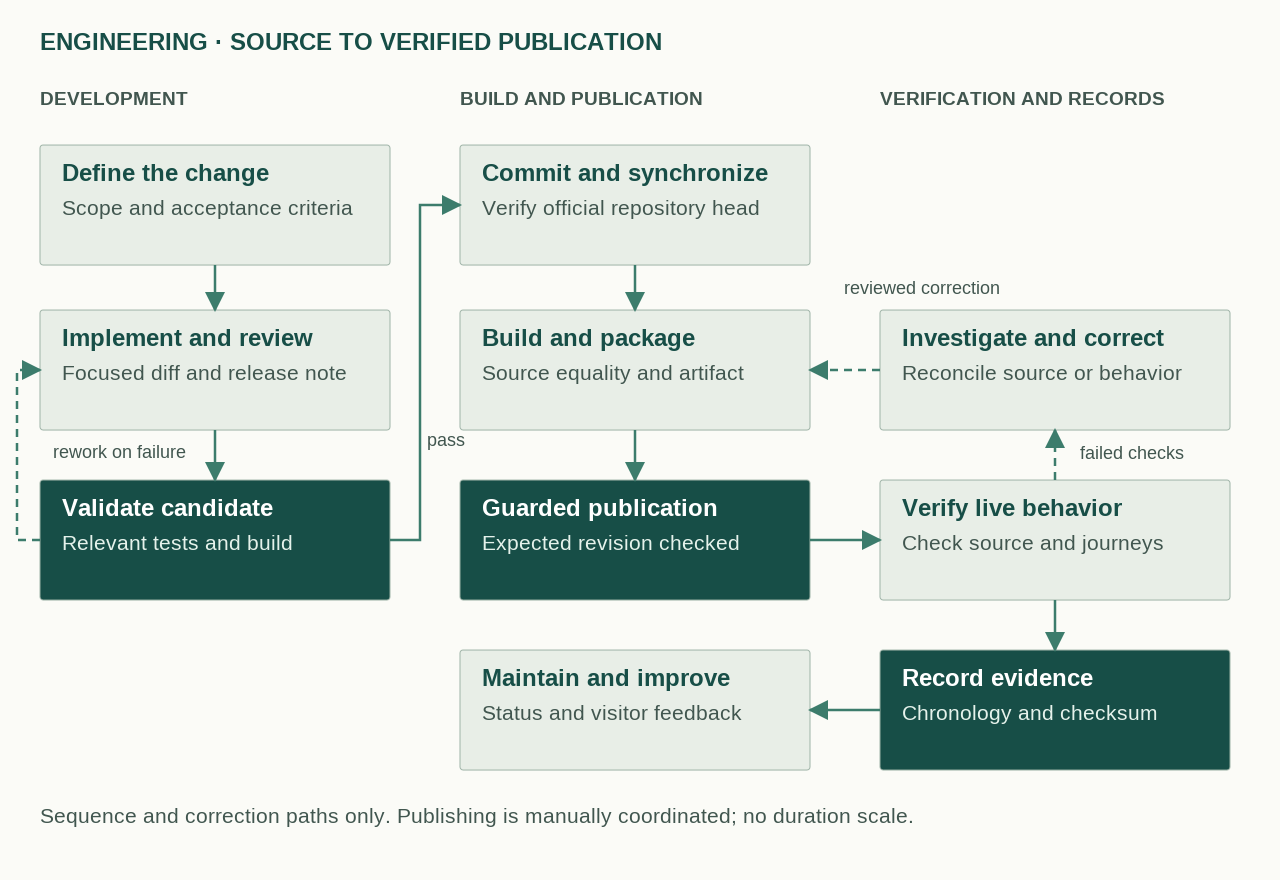
Develop, verify, record, maintain.
The work advances on observed outcomes. Validation scope follows the change; a small copy edit and an authentication change need different evidence.
- Delivery stage
Define the change
Establish the user-visible problem, affected routes, acceptance criteria and preservation requirements. Identify any content or data work that must be handled separately from code.
Expected output: A reviewable change scope and acceptance checklist.
- Delivery stage
Implement and inspect
Modify the relevant source and shared components. Inspect the complete diff for unrelated edits, generated files or accidental credential inclusion. Keep public explanations aligned with implemented behavior.
Expected output: A focused source diff and updated public change notes.
- Delivery stage
Validate the candidate
Run checks appropriate to the behavior that changed and produce a validation build. For visual work, inspect the affected layout and interaction. Resolve failures before advancing.
Expected output: Actual command results and scoped visual or functional observations.
- Delivery stage
Commit and synchronize
Commit source and detailed release notes, update the approved GitHub branch and verify the returned head. Local source and the official repository can have different commit identities; file equality matters.
Expected output: A verified official repository commit and matching source files.
- Delivery stage
Build and package
Build the verified GitHub source with its exact commit reference. Preserve build-process timing, compare sanitized source files and prepare the production archive. Keep the exact archive used for upload.
Expected output: A production artifact tied to source, lockfile and build identity.
- Delivery stage
Publish with a revision guard
Upload to the existing Wix site using the expected source revision. If another writer changed that revision, refresh the source and reconcile before another publication attempt.
Expected output: A successful provider response with deployment and stored-source identifiers.
- Delivery stage
Verify the public result
Check the released source, requested behavior and relevant public resources. Record actual confirmation and verification times; do not substitute commit dates or build completion for publication evidence.
Expected output: A source-matched live verification record and scoped results.
- Delivery stage
Record and maintain
Publish the post-release evidence separately, including artifact checksum, recorded checks and build timing. Monitor the public status route and investigate feedback without treating a past check as continuous assurance.
Expected output: A retained deployment record, release note and next maintenance actions.
Post-publication metadata may become the latest GitHub commit while the website still runs the application built from an earlier source commit. A revision difference is an equality result; it does not by itself identify undeployed application changes.
Advance when the evidence fits.
These are review criteria for the coordinated workflow. They are not claims of automatically enforced branch rules, independent approval roles or guaranteed checks on every historical release.
| Review point | Expected evidence | Hold condition | Next action |
|---|---|---|---|
| Scope review | Clear acceptance criteria and affected pages. | Unclear behavior or a change beyond the authorized scope. | A narrower change statement or the missing decision. |
| Source review | Focused diff; credentials and generated output excluded. | Unexpected deletions, private data or unrelated modifications. | Corrected diff and repeat inspection. |
| Validation | Relevant checks pass and the production candidate builds. | A failed check or observed functional regression. | Resolved failure with the appropriate check rerun. |
| Repository identity | Official branch reference verified; committed files compared. | Repository movement or mismatched source files. | Refresh the reference, reconcile source and rebuild if inputs changed. |
| Publication | Wix accepts the guarded upload and reports the release live. | Source-revision conflict, refused upload or provider failure. | Resolve the reported cause; retain the last confirmed live release. |
| Live behavior | Released source matches, affected journeys work, relevant resources respond correctly. | Wrong source, missing page, broken navigation or failed reporting resource. | Investigate and publish a verified correction or reviewed recovery build. |
| Evidence | Build identity, artifact and chronology match the released source. | Unmatched or missing evidence. | Leave the record pending until a valid matching record is available. |
Functional and visual review.
- Open new or changed routes directly and follow the links that lead to them.
- Inspect text wrapping, spacing, tables and image legibility at the affected widths.
- Check headings, meaningful image descriptions, keyboard focus and disclosure behavior where changed.
- Retest shared navigation or layout when the edited component affects multiple pages.
Technical review.
- Confirm that privileged code and credentials remain on the server.
- Review validation, bounded external reads and fallback behavior when an integration changes.
- Check dependency and lockfile compatibility when dependency inputs change.
- Record what was actually checked and identify any limitation that affects the release.
Measurements tied to this build.
The chart reads the same validated evidence as the deployment record. It remains pending until both source identity and build-start timestamp match.
- Build process duration
- 6.749 seconds
- Recorded regression checks
- 86 / 86 passed
- Source files matched
- 347
Build started . This chart uses evidence matched to this build’s exact source commit and build-start timestamp. Inspect the deployment evidence.
| Artifact or record | What it establishes | Interpretation limit |
|---|---|---|
| Source commit | The approved source snapshot on the official repository. | A commit alone is not proof that Wix published the website. |
| Build number and version | Identifiers captured once during compilation. | Opening a page does not create a build; a metadata-only commit does not replace the application. |
| Build-process timestamps | Observed start, finish and elapsed local build time. | Build completion does not establish deployment completion. |
| Archive SHA-256 | Checksum of the exact ZIP supplied to the upload workflow. | A checksum identifies bytes; it is not a digital signature or signed CI provenance. |
| Publication confirmation | The recorded time Wix reported the release live. | When an exact provider completion timestamp is unavailable, confirmation is labelled as such. |
| Live verification | A successful, source-matched check of the configured scope. | A point-in-time check is not continuous monitoring or independent certification. |
| Release-note ID | Stable public identity for an approved change note. | The GitHub reference identifies the note snapshot, not a guessed original deployment. |
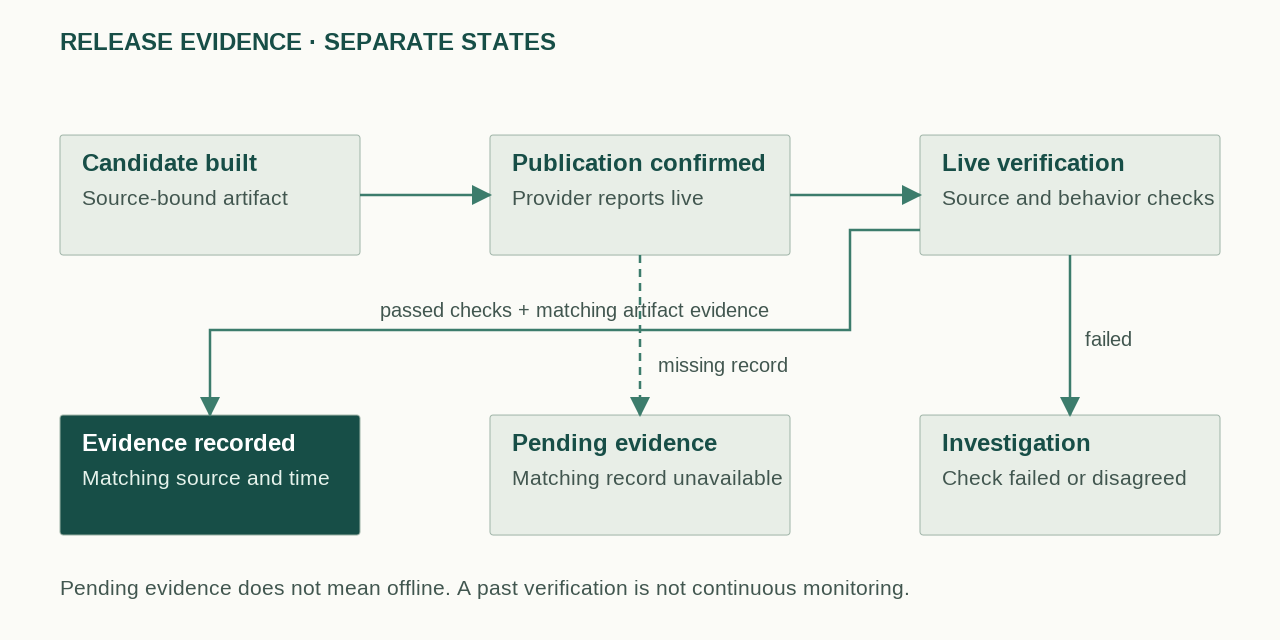
Recover from a known source.
Use the failure that was observed to choose the next action. Keep the existing source, upload artifact and provider response available during investigation.
Correct the candidate.
A test or build failure prevents that candidate from advancing. Fix the relevant input, rerun appropriate checks and create a reviewed source revision. A failed local build does not establish that the live site changed.
Reconcile the source.
A source-revision conflict indicates another update. Retrieve the current source, compare changes and carry the intended edit forward. Rebuild the reconciled source before preparing another guarded upload.
Verify the correction.
Investigate failed live behavior and select a reviewed correction or a known working source. Publish through the same build and guarded upload path, then verify the public result and record new evidence.
Rebuilding a prior source revision can restore application behavior, but does not restore CMS contents, tenant permissions, external service state, secrets or DNS. A change involving those resources needs its own recovery plan. This public page does not perform a rollback.
Keep the record useful.
New evidence, dependency changes and visitor reports inform the next change. Maintenance is an ongoing responsibility rather than a completed diagram stage.
Operational follow-through.
- Separate live service availability from release verification; use the public status route for incident information.
- Review stale fallback records, failed synchronization and reporting routes when a problem is observed.
- Retain relevant release references and describe the actual validation scope.
- Review dependency updates as changes, including compatibility and the need to rebuild.
Improvement measures.
- Use recorded build duration and incident or review findings to identify work worth investigating.
- Compare repeated measurements only when scope and collection method are comparable.
- Keep proposed targets separate from measured results; this page invents no uptime percentage, release frequency or maturity score.
- Return architectural changes to the Architecture Lifecycle before expanding a trust or data boundary.
Are these gates enforced automatically?
The described process is manually coordinated. This update does not configure GitHub Actions, mandatory reviewers, branch protection or automated Wix publication.
Does a passed release check establish security compliance?
No. A scoped functional check, source comparison or successful production build establishes only its recorded outcome. Security assessment and accessibility certification require their own scope and evidence.